
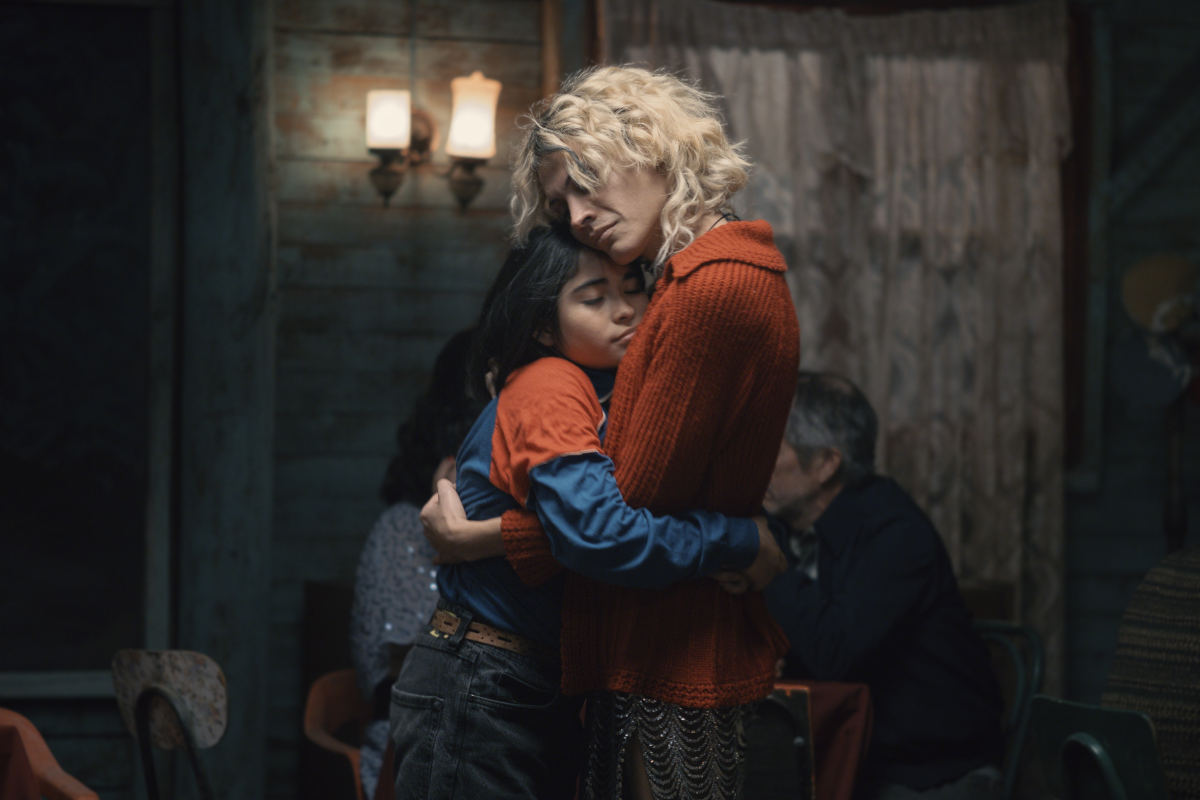
Our review of the Chilean film ' The Mysterious Gaze of the Flamingo' by Diego Céspedes.
Gazes (and the lack of the gaze) are tremendously important in the somewhat fussy but empathetic film by the Chilean Diego Céspedes, 'The Mysterious Gaze of the Flamingo' (winner of the Un Certain Regard prize at the 2025 Cannes Film Festival).
Set perfectly in the western drama of love and HIV in northern Chile of the 80s, the film seeks to investigate the power of love vs. the power of prejudice in an area where men work in the mines. Men reluctantly bond (some archival footage at the film's start shows them indifferent), yet they prefer to hang out at a queer canteen run by Mama Boa (the terrific Paula Dinamarca). Until HIV hits, and its prejudices take center stage; one of which tells that people can get infected simply by being gazed upon by an infected person. Saramago's 'Blindness' here takes a very rural turn.
Yet the film is the story of the 12-year-old, Lidia (the gutsy Tamara Cortés, serving admirably as an anchor to the film's narrative threads). Abandoned by her mother in the middle-of-the-nowhere queer canteen, she's being taken care of by the beautiful and caring (but sometimes reckless) Flamenco (Matías Catalán). In an almost Almodovarian fashion, Flamenco (an HIV-positive person) has love troubles of her own. Her violent and hopeless gay macho lover, Yovani (Pedro Muñoz), still becomes the catalyst for the film's narrative arcs. Throughout the film, Lidia needs to navigate the space between muted hatred, expressed violence, and unabashed care, and learn to choose the appropriate response for each occasion.
Diego Céspedes' film uses its coming-of-age trope (and lessons to be learned) to navigate the narrative and visual space as a matter of course. Group violence is showcased from the start (the bullying Lidia endures at the lake, an almost perennial source of crime), yet it is presented as part of everyday life in the desert, where all characters operate. His emotive feel (in all kinds of sounds, gazes, and breaths) never loses its grip, even though the narrative tension falters after the first (dramatic) third of the film. A highly effective lake scene, entirely shot as a wide shot (which evokes similar themes in Charles Laughton's 'The Night of the Hunter'), is followed by a post-grief narrative focus that doesn't fully stand up to the film's earlier, highly charged section.
That said, 'The Mysterious Gaze of the Flamingo' plays with the nuances, being more of a Joshua Logan mildly adventurous, mildly meditative 'Bus Stop'or 'Picnic' film than a full melodrama. The saloon atmosphere in the queer canteen (even with its pageant) still feels ingrained (and rightly so) in its American soil, with queer queens enjoying their moment of fame. More queer characters (self-named transvestites here) get more screen time to tell their own origin stories. At the same time, Lidia somehow disappears from the narrative, living her own, well-made (but rather perfunctory) romance. Progressively, the queer canteen group scenes take a life of their own, away from Lidia's POV: the blindfolded dance scene is handled masterfully in its tone from violence to tenderness, and showcases much of the moral atmosphere the film wants to convey.
The final third of the film brings all threads together, adding a more optimistic (and realistic) vibe to the whole question of the plague (the lack of love) it examines. 'The Mysterious Gaze of the Flamingo' is in love with the wonderful vistas it portrays, but somehow it misses the opportunity to linger too much on them, with wide shots mostly as a matter of glimpsing awe -before it returns to its character. Yet its cinematography (especially the night scenes) deftly explores elements of magical realism (to which the film returns for its needed, re-connection ending). Its music, from the jazz trumpet sounds to the Latino feel of the songs, always presents a Western feel as a fine homage, now adapted for its queer content (the varied score by Florencia Di Concilio).
The ensemble performance effort does miracles for the film; like Lidia, we feel the characters breathing and, as the title suggests, we get lost in their Gaze. 'The Mysterious Gaze of the Flamingo' is a welcome mix of Western tropes and queer drama, not always realized to its fullness; it still works as a deeply empowering story of an era (the AIDS epidemic) and stigmatized people who offer unabashed care -instead of blindfolds.
Vassilis Kroustallis
