
Film review for the Serbian documentary Landscapes of Resistance by Marta Popivoda, premiered at the 50th IFFR.
It is a really long trip and showcase (but a timely paced film) that Serbian filmmaker Marta Popivoda and writer Ana Vujanović portray in the recent documentary Landscapes of Resistance. The 97-year-old Sonja (Sofija Sonja Vujanović) appears on screen, frail but still determined to take care of herself in any way she can -she has a caregiver besides her. Her story and her narration unfold linearly, but the mode of the directorial presentation is anything but conventional.
10 years of interviews with both Sonja's granddaughter Ana Vujanović and her partner, Marta Popidova (now both in Berlin) result in a visual palimpsest of memories that unfolds in the ever-present Serbian forests, as if trying to enter into the past and not let go of its knowledge fruits.
Sonja was born in Petka, a village near Valjevo in Yugoslavia; her early school years were indelibly inscribed by her initiation to communism (herself being a member of the Yugoslav Communist Youth). Her love interest Sava (Saša) Stanišić, a secretary of the district committee of SKOJ (Yugoslav Communist Youth), was also her first husband; when Sonja was expelled from school due to her communist ideals, she then married Sava in Belgrade -even though she was underage. As she herself states, Sava and his friends had the connections and a 'communist' priest to marry them.
When war erupted and the Axis powers occupied Yugoslavia, Sonja and Sava became part of the partisan resistance; with Sava's death, Sonja had her own incredible trajectory of fighting. Being arrested, beaten, tortured, and sent from Belgrade to Auschwitz as a political prisoner, she presents an unflinching portrait of the fight against all odds.
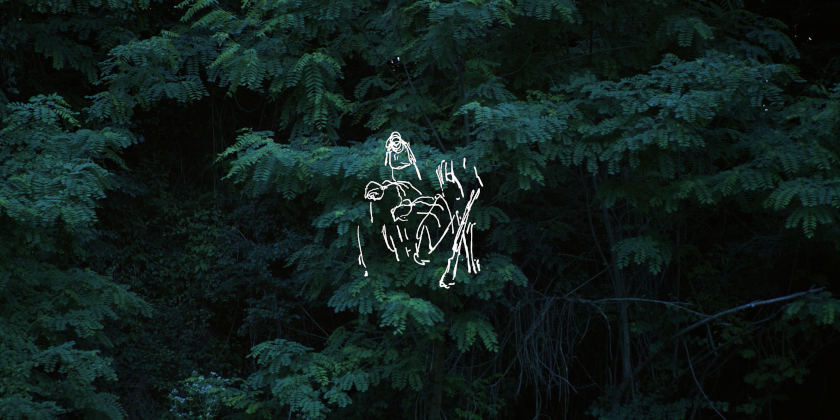
This is visually accompanied by an array of gradually dissolving and emerging images of foliage, forests, caves, and room walls. Sonja's first-person narration is glued to those images (appropriately called 'verbal images') in a film that only cuts in the narration intermezzos with Sonja's everyday chores, but will not cut within Sonja's narration itself. There is a certain solemnity in bringing the words to penetrate the immaculately photographed nature, as if the natural habitat can somehow ease and reconfirm that a purpose of resistance is visible after all.
Tracking shots accompany the Auschwitz trip; the famous place still looks somehow manageable as an experience here, thanks to Sonja's voiceover and her unwillingness to succumb to her fate, but to protest and organize at all costs.
Present-day Sonja herself contrasts with her earlier self and 2007 footage taken by the directors/writers, a compassionate moment in a film which digs deep into the human need for self-fight.
Landscapes of Resistance is quick to relate to the far-right wing aspect of the contemporary European political scene, and the experience the queer couple and filmmakers relate to; still, it won't show the current urban landscape where such interactions (and opposing manifestations) occur, and this weakens its purpose; Serbia's own brutal version of capitalism would be represented best as a current-day image, and not as part of screen titles.
Unapologetically partisan and carefully constructed to showcase its subject and her own past-to-present life journey, Landscapes of Resistance is still an intimate and heartfelt portrait of a woman who found her purpose early in life and fought hard to make it happen.
CREDITS:
Landscapes of Resistance (Pejzaži otpora, 2021, 95' / Serbia, Germany, France)
Director and writer:Marta Popivoda | Writer and dramaturge: Ana Vujanović | Director of photography: Ivan Marković | Editor: Jelena Maksimović | Sound designer:Jakov Munižaba | Producers: Dragana Jovović and Marta Popivoda (Theory at Work), Jasmina Sijerčić (Bocalupo Films) | Executive producer: Zsofi Lili Kovacs | With: Sofija Sonja Vujanović, Ivo Vujanović
Landscapes of Resistance premiered at the 50th International Film Festival Rotterdam (Tiger Competition).
