
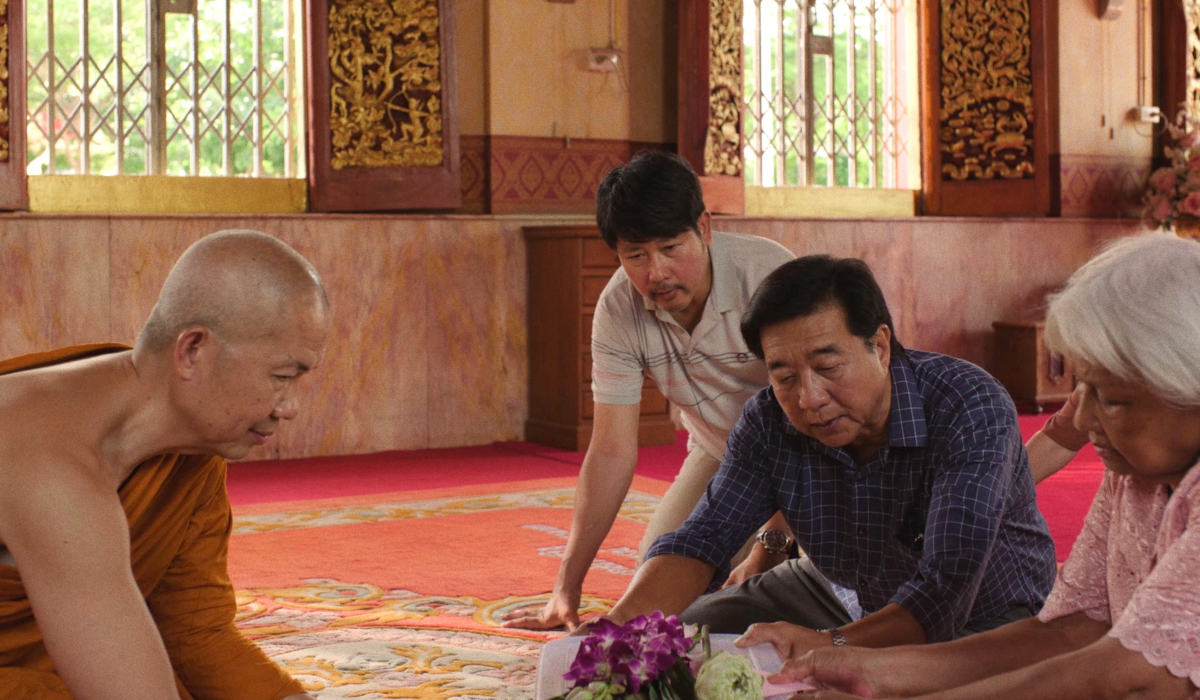
Vassilis Kroustallis reviews the Thai debut feature film '9 Temples to Heaven'.
Nine ('kao') is a lucky number in Thailand, symbolizing progress and advancement (also associated with Thailand's late King Bhumibol, Rama IX). It is also the central concept in the rather unruly but still calmly meditative and slowly engrossing '9 Temples to Heaven' by Sompot Chidgasornpongse (Cannes' Directors Fortnight). The film is also the director's feature debut, a longtime collaborator of Thai arthouse maverick Apichatpong Weerasethakul (Uncle Boonme Who Can Recall His Past Lives, Memoria), who produces it (with Kissada Kamyoung and his Kick the Machine company). '9 Temples to Heaven' becomes a non-judgmental film about life, death, and social mores. It shares Ozu's (even more than Weerasethakul's) family worries, but presents them in the context of a road trip.
While the film gradually opens and is lit by a temple (and bookends with a similar pic), the story of 9 people traveling for soul and body redemption is unveiled. The easily manipulated Sakol (Surachai Ningsanond) decides to take his mother and Grandmother Saluay (the magnificently weary Amara Ramnarong) on a road trip and one-day pilgrimage to nine temples. His boss (acting as a fortune-teller) has indicated that something bad will happen to Grandmother Saluay before her birthday, in two weeks; the only solution is to do this temple pilgrimage as fast as possible, and the whole family (at least most of it) obliges. Sakol's wife, brother, sister, and children (a total of 9 people) all go on a van trip from the coastal city of Samut Prakan (and the director's own city) to a temple-hunting trip.
Somewhere between Anthony Minghella's 'The English Patient' (1996, the scenes of Juliette Binoche admiring the frescoes) and Roberto Rossellini's 'Journey to Italy' (1954, with its religious procession scene), '9 Temples to Heaven' examines carefully a world in which superstition meets tradition meets modernization. Without a solid moral compass (in a country that has suffered from military coups in recent years), religious faith becomes more of a custom that no one knows whether to update or not. With the relationships among family members loose but not tense, everyone on the trip seems to seek a certainty that is always challenged. While Grandmother Saluay becomes increasingly frail, others are free to express their own worries.
The first point of reference, the monks, also do not offer solid knowledge. Their meditation offers ("the mind wanders like a monkey and needs to be trained", one of them suggests) offer little consolation in an existing issue where Grandma's mind seems just to wither away. At the same time, the character of the different monks, old and young, gives us a portrait of an elite that is equally at a loss with its task. Some monks need to disrobe and serve in the army, while others face the increasing demands of modernization. (In one of the film's funniest moments, Grandma Saluay is offered an elevator to reach the top of the nine-floor temple to ascend to heaven much faster).
The magnificence of the temple atmosphere (the film includes Wat Bang Phli Yai Klang, which features the largest reclining Buddha in Thailand) contrasts with the ordinary (and very casually lit) day-to-day road trip. '9 Temples to Heaven' is never a mystic film (cinematography: Jonathan Ricquebourg); apart from a central moon sequence, it tells its viewers that life moves on, with or without some of its members, and the static camera lets situations unfold rather than guide them.
While the frail Grandma Saluay gets her own share of attention, the younger characters, especially Tor (Sompop Songkampol) and the young Koon (Poon Sirapob), shine in the film as both characters with their own stories and direct, immediate performances. We tend to believe their own insecurities, especially if they are rooted (as in Koon's case) in traumatic events narrated as if they were part of a documentary subject. This road trip doc aspect is not always to the film's benefit: an array of family connections remains unexplored, especially regarding the female adult character (mostly reduced to one-line observations).
'9 Τemples to Heaven' prefers to be light in musical themes, but fills the screen with a capella songs in all the right places. Its 140-minute running time proves short of tension, but somehow justified in this full of architectural marvels (and ordinary chairs) road trip. The film has a welcome affinity and characters that you immediately relate to. Even though it will not always put its finger on the elements worth pursuing, it gets into the underbelly of an ordinary life in need of salvation and a family community whose own worries are trapped in a grandma's failing health—an unhurriedly cogitative film.
'9 Temples to Heaven' (2026) world premiered at the 2026 Cannes Film Festival (Directors' Fortnight)
Vassilis Kroustallis
